












The pandemic has forced many employers to abandon their normal working arrangements.
You may have allowed employees to work from home, work less hours or move onto a different working pattern to meet government guidelines and accommodate employees’ personal circumstances.
As a result, they may prefer this new way of working, and as the final stage of lockdown is lifted, employers should prepare to receive an influx of flexible working requests from workers who are reluctant to revert to your pre-pandemic set-up.
Watch the short training video below to find out how to manage flexible working requests compliantly.
Any employee with over 26 weeks’ service has the statutory right to request flexible working. However, this doesn’t mean they have a right to be granted flexible working.
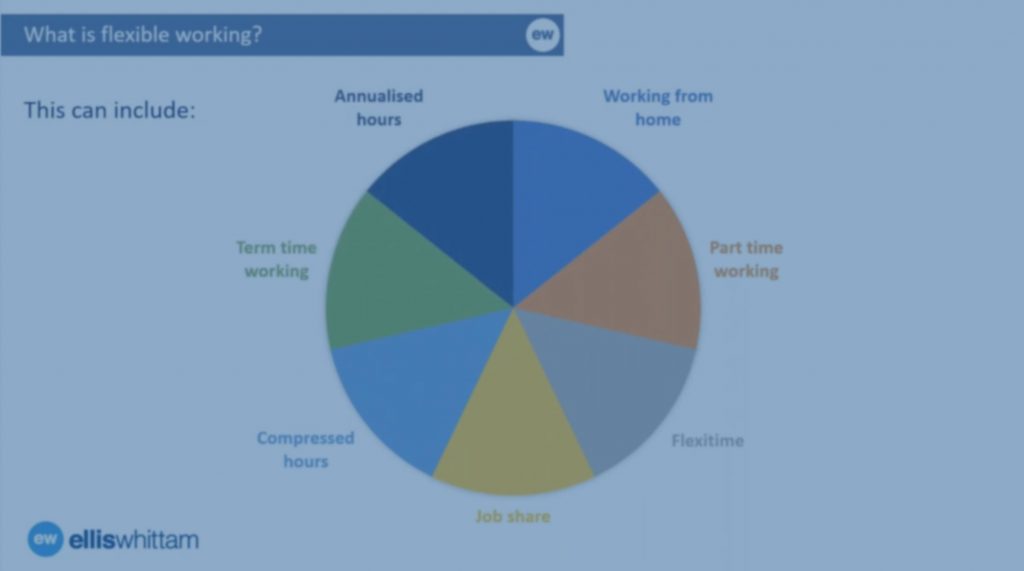
The term itself has become very diverse, encompassing everything from hybrid working, part-time working, term-time working and much more.
Finding a solution that supports the wellbeing of your employees whilst also serving your wider business objectives can be a tough balancing act. Rejecting a request can cause hard-working employees to disengage and handling the process incorrectly could land you with a costly Employment Tribunal claim. At the same time, you have a business to manage, and ensuring high-levels of productivity are maintained and objectives are met will always be a top priority.
To help business owners and senior managers get it right, Employment Law expert David Eastwood has produced a free short training video to guide you through the key factors employers should consider when deciding whether or not to grant a request, as well as the legal process you need to follow and the timeframe you need to adhere to.
During this informative 10-minute session, we cover:
Many businesses have now embraced the ‘new ways of working’ forced upon them by the pandemic, seeing this as an opportunity to bring about a long-term step-change which can be mutually beneficial to both employers and employees.
Indeed, flexible working can support employees seeking to achieve a healthy work-life balance and help employers to remain competitive and recruit and retain talent – provided these arrangements are thought out, implemented and managed properly.
We hope you find this video informative. If you still have unanswered questions, take a look at our Employer’s Guide to Flexible Working.
Owing to our unrivalled support and expertise, we’re consistently high achievers when it comes to protecting organisations, achieving results and recognised as a leading firm by The Legal 500.
We have six times the number of qualified solicitors, practising for over five years, than any of our larger competitors. We’re also recognised by the Legal 500.
With a dedicated adviser in your corner to guide you through the process, you’re over eight times more likely to defeat a Tribunal claim if advised by Ellis Whittam.
Our Health & Safety Team has over 350 years’ combined experience of supporting organisations with their compliance, so you can be sure you’re in safe hands.
Our advice, support and safety management systems can reduce the risk of prosecution by 50% and cut the cost of any fine imposed by more than 85%.
Resources


BLOG Written by Nick Wilson on 29 May 2025 The Health and Safety Executive (HSE) has released its updated Local Authority Circular (LAC 67/2), outlining

BLOG Written by Danielle Fargnoli-Read on 26 February 2025 In the UK, businesses are facing a growing challenge – the skills gap. As the economy

BLOG Written by Danielle Fargnoli-Read on 25 June 2025 Let’s be honest – recruitment can be tough. You spend a lot of time writing job

BLOG Written by Amy Waters on 20 June 2025 Artificial Intelligence (AI) tools are transforming the way employers manage their operations, from streamlining recruitment to

Blog Long-term sickness absence can have a significant impact on any organisation – from increased pressure on colleagues who are picking up the slack, to

BLOG Written by Stuart Watkins on 9 April 2025 Of the many changes contained in Labour’s Employment Rights Bill (ERB), one of the most significant

BLOG Written by Lesley Rennie on 18 March 2025 Back in June 2024, prior to the General Election, we explored the potential for change to

BLOG Written by Louise Harvey on 14 March 2025 The Labour government’s Plan to Make Work Pay is set to shake up numerous aspects of