
BLOG (Updated 16th December 2025)
Promoting a positive workplace health and safety culture
Building a positive health and safety culture is vital across many industries, especially those with high-risks to staff.
A poor health and safety culture can have serious negative results for your business, including injured employees and the potential for damaging employment tribunals. In this expert guide, our expert UK health & safety specialists provide the guidance you need for rigorous, secure policies and practices.
Blog
What is health and safety culture?
It’s your business’ attitude, behaviours, and values for health and safety. By establishing a culture, you can influence the way employees and workers commit to maintaining high levels of risk management at your workplace (whether on or off-site).
As an example, think of a holiday resort business. It would have multiple departments ranging from maintenance, housekeeping, and hospitality, all carrying out different tasks and exposed to different levels of risk, in a variety of working conditions. By establishing rigorous policies respected by all trained members of staff, this can limit the potential for incidents.
Safety Culture Survey
Created by our team of highly-qualified consultants, our Health & Safety Climate Survey is an online tool designed to uncover employees’ attitudes and perceptions to workplace health and safety and provide you with an objective measure of your health and safety culture
Measuring safety culture
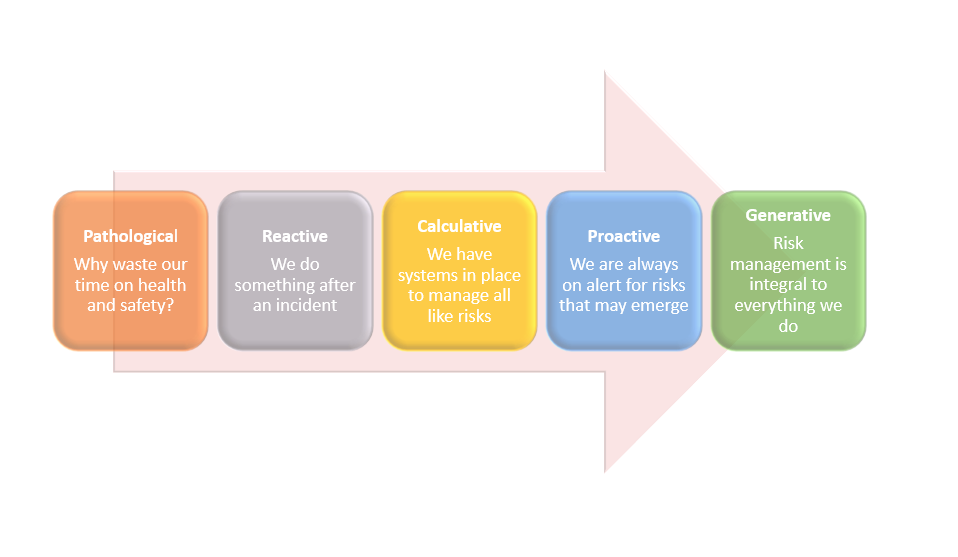
A positive safety culture doesn’t happen overnight; instead, organisations progress through different stages of maturity. This can be thought of as a continuum, ranging from organisations that have unsafe cultures where workers are more concerned with not getting caught (‘pathological’ organisations) through to those that set very high standards and attempt to exceed them (‘generative’ organisations). In generative organisations, safety becomes second nature to everyone.
Your organisation will be somewhere on its safety culture journey. In fact, given the presence of subcultures, you may even find yourself in multiple places on the safety maturity scale. When trying to pinpoint your position, rather than look at your organisation as a whole, consider regional, perhaps departmental, differences in culture. It can sometimes be easy to overlook this, as maybe on the whole you are “good”.
Ask yourself where you think your organisation is, then really self-reflect, are you really there? Then ask yourself what your employees, customers and the general public might say.
This maturity model can be used both as an assessment tool and as an improvement tool. If you’re interested to know where your organisation currently places on the ‘ladder’, our UK health and safety compliance services will help your business meet nationwide regulations.
Benefits of a positive health and safety culture
Improving workplace standards provides many advantages for your business, meaning your investments into training and management can lead to:
- Financial benefits such as enhanced efficiency and productivity
- Reduced staff absence
- Reduced staff turnover
- Morale boosts among employees and management
- Cutting the costs of accidents
- Reducing the risk of damaging employment tribunals
Contrary to what some might believe, cost-effective investment in health and safety is as valuable as any other investment in your company and tackling the causes of accidental losses should not be viewed as an unnecessary overhead but rather an investment in your business.
A combination of reducing accident costs and prevention costs can lead to dramatic savings in your company’s bottom line.

Negative results of poor health and safety culture
With a poorly maintained set of policies and protocols, your business may face:
- Increased accidents (due to risk-taking behaviour and shortcuts being taken, leading to production delays, higher rates of absence, poor staff retention and personal injury claims)
- Inflated insurance premiums (if your performance drops, you are a higher ‘risk’ to insure)
- Fines (as less than favourable working conditions may attract regulatory attention due to concerns being raised or due to an accident which leads to an investigation and possible prosecution)
- Reputational damage and loss of revenue (commercial and domestic buyers are becoming increasingly aware of who they are buying from and how they operate as an organisation or treat their employees)
All of these are bad for business. In fact, while health and safety is often viewed as sitting outside of core business objectives.

The impact on people
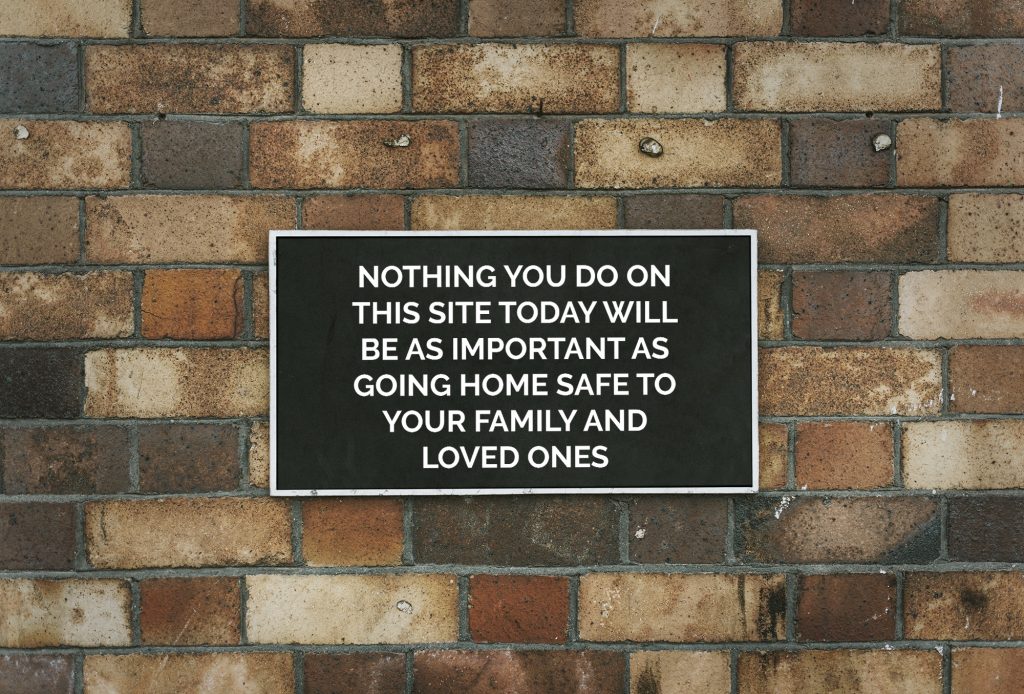
Business benefits aside, it’s important to acknowledge the impact that a poor safety culture can have on people, as they are the outcome of your safety culture and leadership.
Everyone should return home at the end of the day in the same condition they left home that morning. Unfortunately, 111 people died last year as a result of their work. It’s important not to lose sight of the fact that a workplace accident can have devastating effects on not only the injured person but their family too.

The role of leaders
The most successful organisations lead by example, taking a top-down approach to health and safety.
In fact, the HSE states that although many companies use the term “safety culture” to refer to the inclination of their employees to comply with rules or act safety or unsafely, it is the culture and style of management that is even more significant. For example, managers may:
- Have a natural, unconscious bias for production over safety
- Tend to focus on the short-term and be highly reactive
- Ignore health and safety policies and procedures
These attitudes and behaviours can filter down to employees and encourage apathy and risk-taking behaviour. It’s essential you walk the talk, embody the organisation’s values through individual behaviour, and employ industry standard management practices.
How to improve health and safety culture in the workplace
To promote a culture of health and safety in the workplace, your business should aim to:
- Set the direction for effective health and safety management
- Establish a health and safety policy that is much more than a document (it should be an integral part of your organisation’s culture, values and performance standards)
- Take the lead in ensuring the communication of health and safety duties and benefits throughout the organisation
Examples of good practice include:
- Ensuring health and safety appears regularly on the agenda for board meetings
- Appointing a board member as the health and safety ‘champion’
- Appointing a health and safety director to send a strong signal that the issue is being taken seriously and that its strategic importance is understood
- Setting targets to define what the board is seeking to achieve
- Appointing a non-executive director to act as a scrutineer – ensuring the processes to support boards facing significant health and safety risks are robust
In addition, those responsible for leading your safety culture should possess certain qualities. A good leader:
- Has the motivation to prevent harm to anyone
- Ensures a safe place of work for staff
- Has respect for the law and regulations
- Maintains and develops skills, knowledge and experience in themselves and others
- Is objective, fair and reasonable
- Takes responsibility for his own as well as others’ actions
- Acts with conviction
- Provides clear direction and communicates effectively
- Discharges a duty of care to customers, clients and staff
3 things you can do now
In addition to ensuring there is a clear plan from the top – covering what you’re trying to achieve, how, by when, and with who – there are a number of practical ways to strengthen your safety culture:
Participation by employees supports risk control by encouraging their ‘ownership’ of health and safety policies. It establishes an understanding that the organisation as a whole, and people working in it, benefit from good health and safety performance. Pooling knowledge and experience through participation, commitment and involvement means that health and safety really becomes ‘everybody’s business’.
Moreover, successful organisations often go further than what is strictly required by law and actively encourage and support consultation in different ways. Consider involving employees at all levels in activities such as:
- Helping to set performance standards
- Devising operating systems, procedures and instructions for risk control
- Monitoring and auditing
- Participating in ad-hoc problem-solving teams
The objective of benchmarking is to learn from others, uncover your organisation’s strengths and weaknesses in the process, and then act on the lessons learned – leading to real improvement.
- Benchmark internally and externally within your industry, as this will really challenge your perception of what good looks like.
- If you have past reference points to score against, use those; if you don’t, look externally within your industry. Also consider those subcultures and benchmark against the appropriate industry.
- Consider how your safety performance impacts on your culture, engage with your workforce, and benchmark your result.
Look at the return rate on your staff survey; this is a good indicator of engagement across your business and could be a good place to start.
The objective of benchmarking is to learn from others, uncover your organisation’s strengths and weaknesses in the process, and then act on the lessons learned – leading to real improvement.
- Benchmark internally and externally within your industry, as this will really challenge your perception of what good looks like.
- If you have past reference points to score against, use those; if you don’t, look externally within your industry. Also consider those subcultures and benchmark against the appropriate industry.
- Consider how your safety performance impacts on your culture, engage with your workforce, and benchmark your result.
Look at the return rate on your staff survey; this is a good indicator of engagement across your business and could be a good place to start.
Safety culture is dynamic – it’s about reflecting on and reacting to experiences, changes in organisations and expectations of both internal and external stakeholders. The last 12 months has emphasised the need to be dynamic in how we manage change, and safety culture is no different.
Finally, above all, remember your people; safety culture is as broad and diverse as your workforce, with different backgrounds, cultures and tolerances. People are unique and your safety culture approach needs to be too.
Make health and safety everyone's business
If create a positive health and safety culture is a top priority for your organisation this year, our experienced safety specialists can help you to explore different approaches, including a Behavioural Safety Programme, Safety Culture Survey, Mock Trial and more. For more information and to discuss your specific needs, call 0345 226 8393.